
Category: huggingface
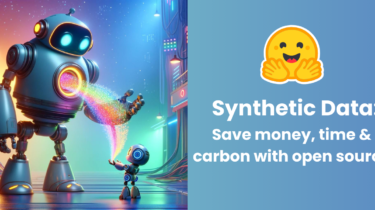
Synthetic data: save money, time and carbon with open source
Should you fine-tune your own model or use an LLM API? Creating your own model puts you in full control but requires expertise in data collection, training, and deployment. LLM APIs are much easier to use but force you to send your data to a third party and create costly dependencies on LLM providers. This blog post shows how you can combine
Read more
🤗 PEFT welcomes new merging methods
Model merging has quickly become the de-facto standard of pushing the performance limits of large language models. On the Open LLM Leaderboard, we continue to notice merged models topping up the charts. Our very own Omar Sanseviero, made
Read more
Introducing the Open Ko-LLM Leaderboard: Leading the Korean LLM Evaluation Ecosystem
In the fast-evolving landscape of Large Language Models (LLMs), building an “ecosystem” has never been more important. This trend is evident in several major developments like Hugging Face’s democratizing NLP and Upstage building a Generative AI ecosystem. Inspired by these industry milestones, in September of 2023, at Upstage we initiated the Open Ko-LLM Leaderboard. Our goal was to quickly develop and introduce an evaluation ecosystem for Korean LLM data, aligning with the global movement towards open and collaborative AI development. […]
Read more
Welcome Gemma – Google’s new open LLM
An update to the Gemma models was released two months after this post, see the latest versions in this collection. Gemma, a new family of state-of-the-art open LLMs, was released today by Google! It’s great to see Google reinforcing its commitment to open-source AI, and we’re excited to fully support the launch with comprehensive integration in Hugging Face. Gemma comes in two sizes: 7B parameters, for efficient deployment and development on consumer-size GPU and TPU and 2B versions for CPU […]
Read more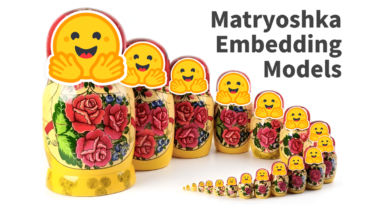
🪆 Introduction to Matryoshka Embedding Models
In this blogpost, we will introduce you to the concept of Matryoshka Embeddings and explain why they are useful. We will discuss how these models are theoretically trained and how you can train them using Sentence Transformers. Additionally, we will provide practical guidance on how to use Matryoshka Embedding models and share a comparison between a Matryoshka embedding model and a regular embedding model. Finally, we invite you to check out our interactive demo that showcases the power of these […]
Read more
Introducing the Red-Teaming Resistance Leaderboard
Content warning: since this blog post is about a red-teaming leaderboard (testing elicitation of harmful behavior in LLMs), some users might find the content of the related datasets or examples unsettling. LLM research is moving fast. Indeed, some might say too fast. While researchers in the field continue to rapidly expand and improve LLM performance, there is growing concern over whether these models are capable of realizing increasingly more undesired and unsafe behaviors. In recent months, there has been no […]
Read more
Fine-Tuning Gemma Models in Hugging Face
We recently announced that Gemma, the open weights language model from Google Deepmind, is available for the broader open-source community via Hugging Face. It’s available in 2 billion and 7 billion parameter sizes with pretrained and instruction-tuned flavors. It’s available on Hugging Face, supported in TGI, and easily accessible for deployment and fine-tuning in the Vertex Model Garden and Google Kubernetes Engine. The Gemma family of models also happens to be well suited for prototyping and experimentation using the free […]
Read more
AI Watermarking 101: Tools and Techniques
In recent months, we’ve seen multiple news stories involving ‘deepfakes’, or AI-generated content: from images of Taylor Swift to videos of Tom Hanks and recordings of US President Joe Biden. Whether they are selling products, manipulating images of people without their consent, supporting phishing for private information, or creating misinformation materials intended to mislead voters, deepfakes are increasingly being shared on social media platforms. This enables them to be quickly propagated and have a wider reach and therefore, the potential […]
Read more
TTS Arena: Benchmarking Text-to-Speech Models in the Wild
Automated measurement of the quality of text-to-speech (TTS) models is very difficult. Assessing the naturalness and inflection of a voice is a trivial task for humans, but it is much more difficult for AI. This is why today, we’re thrilled to announce the TTS Arena. Inspired by LMSys‘s Chatbot Arena for LLMs, we developed a tool that allows anyone to easily compare TTS models side-by-side. Just submit some text, listen to two different models speak it out, and vote on […]
Read more