Calculating Pearson Correlation Coefficient in Python with Numpy

Introduction This article is an introduction to the Pearson Correlation Coefficient, its manual calculation and its computation via Python’s numpy module. The Pearson correlation coefficient measures the linear association between variables. Its value can be interpreted like so: +1 – Complete positive correlation +0.8 – Strong positive correlation +0.6 – Moderate positive correlation 0 – no correlation whatsoever -0.6 – Moderate negative correlation -0.8 – Strong negative correlation -1 – Complete negative correlation We’ll illustrate how the correlation coefficient varies […]

Read more
Automatic Standardization of Colloquial Persian

The Iranian Persian language has two varieties: standard and colloquial. Most natural language processing tools for Persian assume that the text is in standard form: this assumption is wrong in many real applications especially web content… This paper describes a simple and effective standardization approach based on sequence-to-sequence translation. We design an algorithm for generating artificial parallel colloquial-to-standard data for learning a sequence-to-sequence model. Moreover, we annotate a publicly available evaluation data consisting of 1912 sentences from a diverse set […]

Read more

‘Seeing’ on tiny battery-powered microcontrollers with RNNPool

Computer vision has rapidly evolved over the past decade, allowing for such applications as Seeing AI, a camera app that describes aloud a person’s surroundings, helping those who are blind or have low vision; systems that can detect whether a product, such as a computer chip or article of clothing, has been assembled correctly, improving quality control; and services that can convert information from hard-copy documents into a digital format, making it easier to manage personal and business data. All […]

Read more

Globetrotter: Unsupervised Multilingual Translation from Visual Alignment

Multi-language machine translation without parallel corpora is challenging because there is no explicit supervision between languages. Existing unsupervised methods typically rely on topological properties of the language representations… We introduce a framework that instead uses the visual modality to align multiple languages, using images as the bridge between them. We estimate the cross-modal alignment between language and images, and use this estimate to guide the learning of cross-lingual representations. Our language representations are trained jointly in one model with a […]

Read more

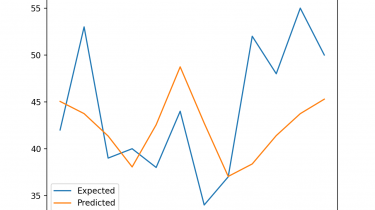
Random Forest for Time Series Forecasting

Random Forest is a popular and effective ensemble machine learning algorithm. It is widely used for classification and regression predictive modeling problems with structured (tabular) data sets, e.g. data as it looks in a spreadsheet or database table. Random Forest can also be used for time series forecasting, although it requires that the time series dataset be transformed into a supervised learning problem first. It also requires the use of a specialized technique for evaluating the model called walk-forward validation, […]

Read more

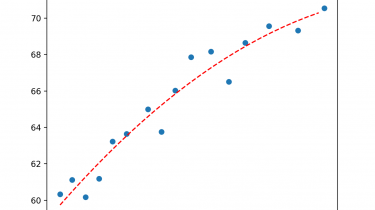
Curve Fitting With Python

Curve fitting is a type of optimization that finds an optimal set of parameters for a defined function that best fits a given set of observations. Unlike supervised learning, curve fitting requires that you define the function that maps examples of inputs to outputs. The mapping function, also called the basis function can have any form you like, including a straight line (linear regression), a curved line (polynomial regression), and much more. This provides the flexibility and control to define […]

Read more

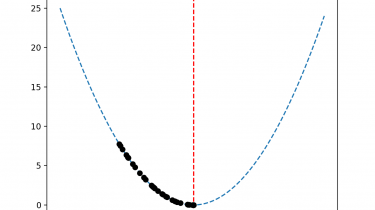
Stochastic Hill Climbing in Python from Scratch

Stochastic Hill climbing is an optimization algorithm. It makes use of randomness as part of the search process. This makes the algorithm appropriate for nonlinear objective functions where other local search algorithms do not operate well. It is also a local search algorithm, meaning that it modifies a single solution and searches the relatively local area of the search space until the local optima is located. This means that it is appropriate on unimodal optimization problems or for use after […]

Read more

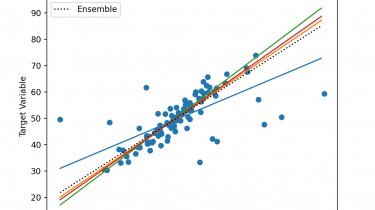
Develop an Intuition for How Ensemble Learning Works

Ensembles are a machine learning method that combine the predictions from multiple models in an effort to achieve better predictive performance. There are many different types of ensembles, although all approaches have two key properties: they require that the contributing models are different so that they make different errors and they combine the predictions in an attempt to harness what each different model does well. Nevertheless, it is not clear how ensembles manage to achieve this, especially in the context […]

Read more

How to Identify Overfitting Machine Learning Models in Scikit-Learn

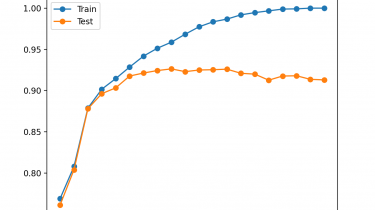
Last Updated on November 27, 2020 Overfitting is a common explanation for the poor performance of a predictive model. An analysis of learning dynamics can help to identify whether a model has overfit the training dataset and may suggest an alternate configuration to use that could result in better predictive performance. Performing an analysis of learning dynamics is straightforward for algorithms that learn incrementally, like neural networks, but it is less clear how we might perform the same analysis with […]

Read more

Multivariate Adaptive Regression Splines (MARS) in Python

Multivariate Adaptive Regression Splines, or MARS, is an algorithm for complex non-linear regression problems. The algorithm involves finding a set of simple linear functions that in aggregate result in the best predictive performance. In this way, MARS is a type of ensemble of simple linear functions and can achieve good performance on challenging regression problems with many input variables and complex non-linear relationships. In this tutorial, you will discover how to develop Multivariate Adaptive Regression Spline models in Python. After […]

Read more
1 769 770 771 772 773 991