Research Focus: Week of June 19, 2023

Welcome to Research Focus, a series of blog posts that highlights notable publications, events, code/datasets, new hires and other milestones from across the research community at Microsoft. In this article NEW RESOURCE Responsible AI Maturity Model As the use of AI continues to surge, new government regulations are expected. But the organizations that build and use AI  

Read more

DeepSpeed ZeRO++: A leap in speed for LLM and chat model training with 4X less communication

Figure 1: Picture of ZeRO++ project highlights. Left top subfigure shows ZeRO++ reduce communication volume by 4x compared with ZeRO stage 3. Right top subfigure shows ZeRO++ performance on RLHF model training, where ZeRO++ achieves 1.3x speedup for RLHF training and 2.x speedup for token generation. Large AI models are transforming the digital world. Generative language models like Turing-NLG, ChatGPT, and GPT-4, powered by large language models (LLMs), are incredibly versatile, capable of performing tasks like summarization, coding, and translation. […]

Read more

Collaborators: Renewable energy storage with Bichlien Nguyen and David Kwabi

Today I’m talking to Dr. Bichlien Nguyen, a Principal Researcher at Microsoft Research, and Dr. David Kwabi, an Assistant Professor of Mechanical Engineering at the University of Michigan. Bichlien and David are collaborating on a fascinating project under the umbrella of the Microsoft Climate Research Initiative that brings organic chemistry and machine learning together to discover new forms of renewable energy storage. Before we unpack the “computational design and characterization of organic electrolytes for flow batteries and carbon capture,” let’s […]

Read more

Python’s Self Type: How to Annotate Methods That Return self

Have you ever found yourself lost in a big repository of Python code, struggling to keep track of the intended types of variables? Without the proper use of type hints and annotations, uncovering variable types can become a tedious and time-consuming task. Perhaps you’re an avid user of type hints but aren’t sure how to annotate methods that return self or other instances of the class itself. That’s the issue that you’ll tackle in this tutorial. First, though, you’ll need […]

Read more

Recursion in Python

If you’re familiar with functions in Python, then you know that it’s quite common for one function to call another. In Python, it’s also possible for a function to call itself! A function that calls itself is said to be recursive, and the technique of employing a recursive function is called recursion. It may seem peculiar for a function to call itself, but many types of programming problems are best expressed recursively. When you bump up against such a problem, […]

Read more

Microsoft at CVPR 2023: Pushing the boundaries of computer vision

In the vast realm of artificial intelligence, few fields have captivated our imagination and pushed the boundaries of possibility quite like computer vision. At the core of this domain of research and innovation lies the ambition to empower technologies for real-world vision-based systems, enabling machines to take in and respond to visual stimuli with unparalleled precision and sophistication. Through the combination of AI, deep learning, and vast amounts  

Read more

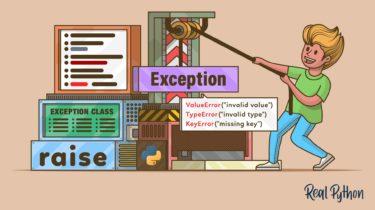
Python’s raise: Effectively Raising Exceptions in Your Code

In your Python journey, you’ll come across situations where you need to signal that something is going wrong in your code. For example, maybe a file doesn’t exist, a network or database connection fails, or your code gets invalid input. A common approach to tackle these issues is to raise an exception, notifying the user that an error has occurred. That’s what Python’s raise statement is for. Learning about the raise statement allows you to effectively handle errors and exceptional […]

Read more
1 224 225 226 227 228 1,071